

- What Is a Tooth Extraction?
- When Do Dentists Recommend Tooth Extractions?
- How Dentists Determine Whether a Tooth Should Be Extracted
- Can a Tooth Be Saved Instead of Extracted?
- What Happens During a Tooth Extraction Procedure?
- Tooth Extraction Recovery and Aftercare Tips
- What Are the Options for Replacing an Extracted Tooth?
- When to Contact a Dentist Immediately
- Frequently Asked Questions
- Conclusion
There are just a few things people actually fear hearing from the dentist’s mouth – and “we need to extract that tooth” definitely tops that list. No matter how long a tooth has been bothering you, the very thought of extracting it somehow seems different from a simple filling or cleaning procedure. And really, there is nothing wrong with that feeling.
At Haraz Dental Group, we don't take that recommendation lightly either. We look at every angle before we get there. But when extraction is genuinely the right move, we've found that patients feel a lot better about the whole thing when they actually understand what's driving the decision — and what their life looks like on the other side of it.
What Is a Tooth Extraction?
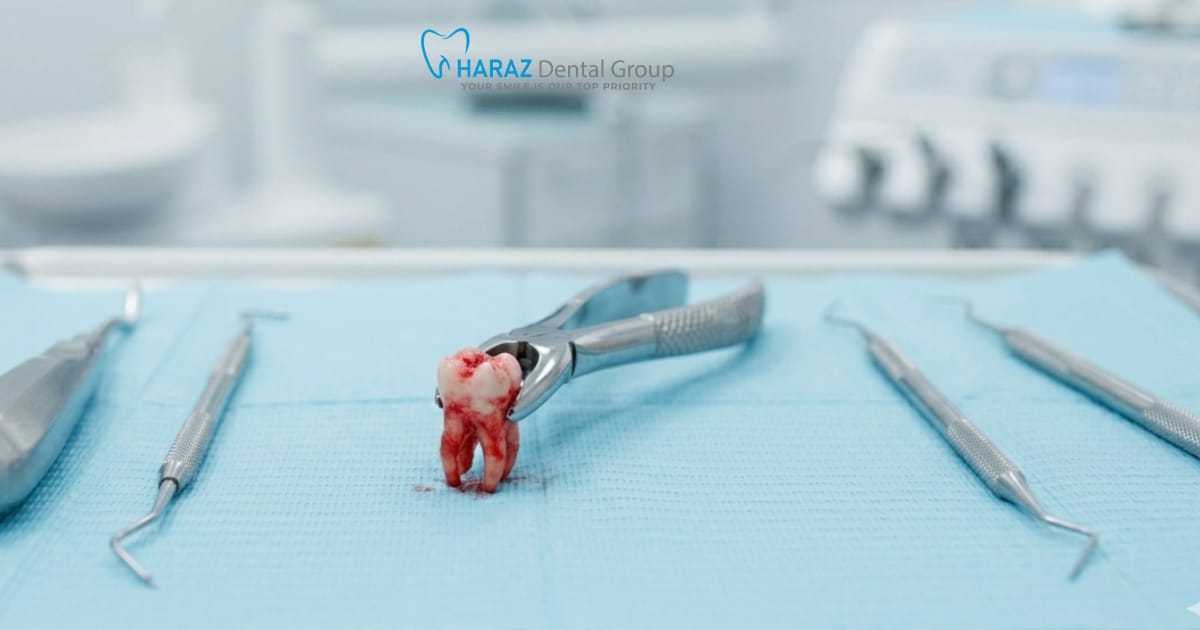
Put simply, a tooth extraction is removing a tooth from the socket it lives in inside your jaw. That can happen one of two ways. A simple extraction is exactly what it sounds like — the tooth is visible, accessible and comes out with local anesthesia and the right instruments. A surgical extraction is used when a tooth is broken off at the gum line, sitting beneath the surface, or positioned in a way that makes straightforward removal impossible.
What most people are surprised by is how quick the actual procedure is. With proper anesthesia, you feel pressure — sometimes a fair amount of it — but not the sharp pain most people are bracing for. The recovery afterward and what you decide to do about the gap it leaves, tends to be the bigger conversation.
When Do Dentists Recommend Tooth Extractions?
There's no single reason a dentist recommends taking a tooth out. It comes down to a combination of factors specific to that tooth, that patient and that moment in time. Here are the situations where extraction most commonly becomes the answer.
Severe Tooth Decay Beyond Repair
Decay doesn't stay on the surface. Given enough time, it works its way through the enamel, through the dentin and eventually into the pulp — the soft inner part of the tooth where nerves and blood vessels run. Once it's that deep, a root canal can sometimes still save the tooth. But when the decay has taken so much of the tooth's structure that there's nothing solid left to build on, there's no good option for preserving it. At that point, extraction isn't giving up — it's preventing the infection from spreading to the teeth and bone around it.
Advanced Gum Disease (Periodontitis)
Caught early, gum disease is manageable. The problem is that periodontitis often progresses quietly — people don't always feel it happening until it's already done real damage. What it does, over time, is destroy the bone and connective tissue that anchor your teeth in place. When that support is gone to a certain degree, a tooth can become so mobile that it can't function and can't be stabilized no matter how good the treatment is. Removing it stops the infection from continuing to eat away at the surrounding bone.
Impacted Wisdom Teeth
The jaws of most people cannot accommodate wisdom teeth. In cases where there is no room, these teeth get impacted. They push sideways, squeeze the roots of other teeth and create pockets that become a breeding ground for bacteria that is difficult to reach. Some people may not have any problem with their wisdom teeth while some have pain and infections arising out of them. In either case, the usual advice of dental professionals about impacted wisdom teeth is prevention of problems instead of suffering from them.
Broken or Fractured Teeth
Some types of fractures are repairable – the tooth can be protected by a crown so that it will continue to work for many years. However, when a crack goes down towards the root, or if a tooth breaks off below the gum line, then there is no surefire way to repair it that will make it last. It is going to cause problems either way – including pain, infections and inability to perform the function of a tooth.
Overcrowded Teeth Before Orthodontic Treatment
This one surprises people sometimes. If your teeth are too crowded for braces or aligners to work properly, your orthodontist may need space to actually move them into position. That sometimes means removing a tooth — or a couple of teeth — before treatment begins, so the remaining teeth have somewhere to go. It's a planned, strategic removal that makes the end result of orthodontic treatment actually achievable.
Dental Abscess or Severe Infection
An abscess is an infection, usually at the root of a tooth or in the gum beside it, that has formed a pocket of pus. Root canal treatment and antibiotics clear it up in a lot of cases. But when the infection is severe, when it keeps coming back, or when it's spread into the surrounding bone or tissue, extraction becomes the only way to fully remove the source. An untreated dental abscess doesn't stay contained — it can become a genuinely dangerous situation if ignored long enough.
Trauma or Injury to the Tooth
Fall, blow to the mouth while playing sports, or even an accident involving the car may cause serious physical damage to the teeth. The viability of the tooth in question will depend on the extent of the injury and how quickly the patient seeks the dental attention. In cases where the tooth is fractured or its root has been severely damaged or broken, extraction becomes necessary to proceed to the next step.
How Dentists Determine Whether a Tooth Should Be Extracted
No one should be suggesting a tooth extraction from a superficial examination. This includes a comprehensive clinical evaluation, x-rays to show the state of affairs below the gums and a real discussion on the patient’s overall dental health status and expectations. There is an assessment by the dentist regarding the extent of the damage, the state of health of the bone and tissues around the tooth to support a restorative procedure and whether retaining the tooth is doing more harm than good.
Whenever your dentist recommends a tooth extraction, ask him or her the reasons behind the decision. A good dentist would appreciate such a question.
Can a Tooth Be Saved Instead of Extracted?
This is always the first thing worth asking. In plenty of situations, the answer is yes — and these are the treatments that get considered first.
Root Canal Treatment
When infection or decay has gotten into the pulp, a root canal goes in, removes everything damaged, cleans out the canals and seals the tooth off. Then a crown goes on top to protect it. The reputation root canals have for being awful is mostly outdated — modern techniques have made them far more manageable. And for a tooth with a solid root structure, it can mean keeping that tooth for decades.
Dental Crowns
When a tooth is cracked or broken but the root is still in good shape, a crown can cap it — restoring how it looks, how it functions and protecting it from further damage. It's one of the most common ways to avoid extraction when a tooth has been compromised but not destroyed.
Periodontal Treatment
If gum disease is caught before it's destroyed too much bone, deep cleaning procedures like scaling and root planing give the gum tissue a chance to reattach and heal. Sometimes that's combined with medication or minor surgical treatment. The difference between catching periodontitis early and catching it late is often the difference between saving a tooth and losing one.
What Happens During a Tooth Extraction Procedure?
The first thing your dentist does is make sure you're completely numb. That part matters — nothing else happens until the anesthesia has done its job. For a simple extraction, the tooth gets loosened with an instrument called an elevator before it's removed with forceps. The sensation is pressure, sometimes significant, but not pain.
Surgical extractions involve a bit more — sometimes a small incision to access the tooth, sometimes dividing the tooth into sections to make it easier to remove without force. Stitches may go in afterward to help the gum close properly.
People are often surprised that the procedure itself is over faster than they expected. Most of the experience — and most of the care instructions — come after.
Tooth Extraction Recovery and Aftercare Tips
The first 24 hours are the most important. A blood clot forms in the socket where the tooth was and that clot is what the whole healing process is built on. Anything that dislodges it — straws, forceful rinsing, smoking, spitting — sets things back considerably and can cause a painful complication called dry socket.
After that first day, things get more straightforward: soft foods, gentle cleaning around the area, ice packs in the first day or two for swelling and staying on top of any prescribed medication. Most people feel meaningfully better by day three or four.
The sign something has gone wrong is pain that gets worse after the first two days instead of better, or a socket that looks empty and hurts intensely. That's dry socket and it needs to be treated — it won't resolve on its own.
What Are the Options for Replacing an Extracted Tooth?
It is not only an aesthetic issue, but an issue that affects many other aspects. In particular, the adjacent teeth will gradually move into the vacant place, the occlusion will change and the jawbone where there used to be a tooth root will slowly diminish.
Dental Implants
A titanium post gets placed into the jawbone and, over a few months, fuses with the bone. A crown then attaches on top. The result is a tooth that looks right, chews right and actually stimulates the bone the way a natural root does. Implants are the closest thing dentistry has to replacing a tooth with another tooth.
Dental Bridges
A bridge anchors to the teeth on either side of the gap, with an artificial tooth in the middle. It's fixed in place — not removable — and restores function and appearance without surgery. For patients who can't do implants or want a shorter treatment timeline, a bridge is a solid, proven option.
Dentures
Partial dentures fill in for one or a few missing teeth; complete dentures replace a full arch. The dentures available today are a long way from what older generations experienced — better fit, better materials, more natural appearance. For patients replacing multiple teeth, they're often the most practical path forward.
When to Contact a Dentist Immediately
Most extractions heal without drama. But certain things are worth calling about right away, rather than waiting to see if they improve:
Pain that's getting worse two or three days after the procedure, not better
Bleeding that won't stop even with steady pressure
Fever, chills, or swelling that seems to be spreading
Numbness that's lingering well past when the anesthesia should have worn off
A socket that looks bare and bone-dry and hurts intensely
These aren't things to ride out. They're much simpler to deal with when addressed early.
Frequently Asked Questions
What is the most common reason for tooth extraction?
Severe tooth decay is the most frequent cause — a tooth that's decayed too deeply to be saved. Right behind that is advanced gum disease that's destroyed the supporting bone and impacted wisdom teeth that don't have room to come in safely.
Can a severely infected tooth be saved?
Sometimes. A root canal paired with antibiotics resolves a lot of tooth infections successfully. But if the infection has spread extensively, eaten into the surrounding bone, or if the tooth is too structurally compromised to restore, extraction is often the only thing that actually solves the problem rather than managing it temporarily.
Is tooth extraction painful?
During the procedure, no — not with proper anesthesia. Pressure and movement, yes. Sharp pain, no. Afterward, soreness is normal for a few days and almost always manageable with standard pain relief. The idea that extractions are brutally painful is mostly fear carried over from a much older era of dentistry.
How long does it take to recover from a tooth extraction?
Most people turn the corner within two to three days. The gum tissue closes up over one to two weeks. Bone healing underneath takes several months, though you'd never notice that part — it happens quietly while everything else has already gotten back to normal.
What should I avoid after a tooth extraction?
Straws, smoking, spitting and hot drinks are all off the table for at least the first 24 hours — they all threaten the blood clot. Past that, skip anything crunchy or hard that might poke the healing area, hold off on strenuous exercise for a couple of days and avoid alcohol. Your dentist will go over the specifics based on exactly what was done.
Conclusion
Getting a tooth pulled isn't anyone's idea of a good day, but it's also not the end of the world — and for a lot of people, it's genuinely the thing that finally ends weeks or months of pain they'd been putting up with. Dentists don't recommend it casually. When it comes up, it's because keeping the tooth is doing more harm than removing it.
If you're in that position right now — either your dentist has already recommended it or something in your mouth doesn't feel right and you're putting off finding out why — don't sit on it. The sooner a problem gets looked at, the more options tend to be on the table.
You can get a proper evaluation and learn exactly what to expect by scheduling fortooth extraction in Fresno, CA with the team at Haraz Dental Group. We'll tell you straight what's going on, what we think is best and walk you through every step so nothing surprises you.