

- What Is a Root Canal? (And When Do You Need One?)
- What Is a Tooth Extraction? (And When Is It Necessary?)
- Root Canal vs Tooth Extraction: Side-by-Side Comparison
- Root Canal: Pros and Cons
- Tooth Extraction: Pros and Cons
- Cost Breakdown: Root Canal vs Extraction in Fresno, CA
- Recovery: What to Expect After Each Procedure
- What Do Dentists Recommend?
- Ready to Protect Your Smile? Visit Haraz Dental Group in Fresno, CA
- Frequently Asked Questions (FAQs)
You're sitting in the dentist's chair, jaw aching, and your dentist says you have two options — a root canal or a tooth extraction. Right away, a thousand questions start racing through your mind. Which one hurts less? Which one costs more? Which one is actually better for your long-term oral health?
If what you have been looking for is a straight-up comparison, then you have reached the right place. As a professional dentist in Fresno, California, our highly qualified dental specialists at Haraz Dental Group assist our patients in making such important decisions every single day. From comparing root canals vs. tooth extractions, to understanding the pros and cons, associated costs, and healing time, you will find all the information that you require here.
What Is a Root Canal? (And When Do You Need One?)
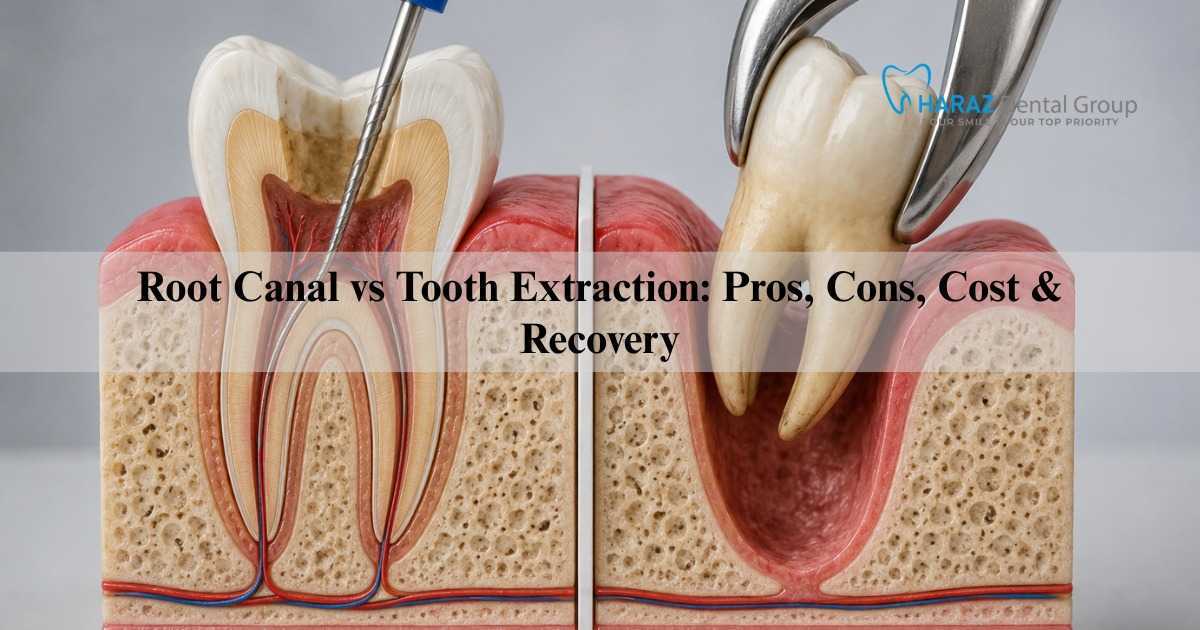
Root canal treatment, also known as endodontic treatment, is a form of dental treatment that aims to save the tooth when it becomes seriously affected by infection. The pulp is located inside the tooth. This consists of soft tissues that contain blood vessels and nerves. Infections in the tooth pulp may cause excruciating pain, swelling, and ultimately lead to the formation of an abscess.
In a root canal treatment, the pulp inside your tooth will be removed and cleaned. Your root canals will then be filled with gutta-percha and sealed. A dental crown is usually placed afterward to protect and restore the tooth's strength and function.
You may need a root canal if you have:
A deep dental cavity that has infected the tooth's pulp
A fractured tooth that exposes the tooth's nerves
Exposure to hot or cold temperatures for long periods
Swollen or tender gums near a specific tooth
Discoloration of a tooth
A persistent pimple or abscess on the gums
What Is a Tooth Extraction? (And When Is It Necessary?)
The process of tooth extraction involves the full removal of the tooth from the socket. The two different kinds of extraction procedures include a simple extraction (which is done under local anesthesia on a visible tooth) and a surgical extraction (which involves cutting the gum around a broken or impacted tooth).
The most common reasons for having a tooth extracted are a heavily infected or decayed tooth, an infection caused by advanced periodontitis affecting the teeth, and impacted teeth (such as the case of wisdom teeth).
Your dentist may recommend extraction when:
The tooth is broken below the gum line and cannot be restored
Severe bone loss has destabilized the tooth
Orthodontic treatment requires more space
The tooth has failed a previous root canal
Infection has spread too extensively to save the tooth
Root Canal vs Tooth Extraction: Side-by-Side Comparison
Factor | Root Canal | Tooth Extraction |
Goal | Save the natural tooth | Remove the damaged tooth |
Procedure time | 1–2 hours (1–2 visits) | 30–60 minutes (1 visit) |
Pain during | Minimal (local anesthesia) | Minimal (local anesthesia) |
Recovery time | A few days | 1–2 weeks |
Long-term outcome | Natural tooth preserved | Replacement needed |
Effect on jaw bone | No bone loss | Gradual bone loss possible |
Cost (without insurance) | $700–$1,500+ with crown | $150–$400 (simple) |
Root Canal: Pros and Cons
Pros of Root Canal Treatment
1.Preservation of Natural Tooth: Your natural tooth is unique in terms of functionality compared to other dental restorations available on the market. By keeping your natural tooth, you protect yourself from the possible misalignment of your bite, displacement of adjacent teeth, as well as changes in the shape of the underlying jawbone. Losing even one tooth can lead to a whole series of dental problems in the future.
2. Long-Term Cost-Effectiveness: Although the cost of a root canal treatment is higher compared to a simple tooth extraction, it is often more economical in the long run because replacing lost teeth by means of implants or bridges involves additional expenses later on
3. Natural Appearance and Function: Following a root canal treatment, crowned tooth will function just as any other tooth does. There will not be anything unusual about chewing or smiling after restoration procedures have been done.
4. Prevents Bone Loss: A natural tooth root stimulates the jawbone. When a tooth is extracted, the bone in that area begins to resorb (shrink) over time, which can affect facial structure and the stability of neighboring teeth.
Cons of Root Canal Treatment
1. Higher Upfront Cost: Root canal therapy combined with a dental crown can run between $1,000 and $2,000 depending on which tooth is treated and your location. For patients without dental insurance, this can feel steep.
2. Multiple Appointments: Some root canals require two visits — one to clean and treat the tooth, and a follow-up to place the permanent crown. This demands more scheduling flexibility.
3. Small Risk of Re-infection: Though rare, a root canal can fail if bacteria re-enter the tooth. A second root canal (retreatment) or surgical apicoectomy may then be needed.
Tooth Extraction: Pros and Cons
Pros of Tooth Extraction
1. Lower Immediate Cost: An extraction usually costs anywhere from $150 to $400, which is much cheaper than a root canal in the short term. This can seem very attractive for someone with budget limitations.
2. Faster Resolution Extraction is a single-visit procedure that immediately removes the source of pain and infection. For teeth that truly cannot be saved, it provides fast relief.
3. Eliminates a Severely Damaged Tooth: For a tooth that cannot possibly be salvaged because it has been damaged too extensively, an extraction will solve the problem.
Cons of Tooth Extraction
1. You Lose a Permanent Tooth:Your adult teeth do not regrow once they are removed. You will need to replace them with dental implants, bridges, or partial dentures.
2. Jawbone Deterioration: Because there is no root to nourish the jawbone tissue, the bone tissue around the gap starts deteriorating. This results in deterioration of the bone mass in that area over time.
3. Teeth Shifting and Bite Problems: With Remaining Teeth Other adjacent teeth start moving into the vacant space, which creates malocclusions. This results in poor ability to chew food along with an increased risk of gum diseases and tooth decay.
4. Replacement Costs Add Up: Replacing the missing tooth through a dental implant could cost you $3,000-$5,000 depending upon the severity of the condition. If you compare this with root canal treatment, tooth extraction seems more expensive.
Root Canal vs Tooth Extraction: Which Is More Painful?
This is the common question and the truthful answer is that since both these methods require local anesthesia, you won’t experience any pain at all during the operation. Afterward, you may feel some pain and it will be possible to take care of it with ordinary painkillers.
The popular belief about root canals being "painful" is not quite true as it is based on old traditions. Nowadays the method is not more unpleasant than getting your tooth filled. On the contrary, as root canal eliminates inflammation of the pulp, patients usually feel much better right away.
Cost Breakdown: Root Canal vs Extraction in Fresno, CA
Treatment | Estimated Cost (Without Insurance) |
Simple Tooth Extraction | $150 – $400 |
Surgical Tooth Extraction | $225 – $600 |
Root Canal (front tooth) | $700 – $1,000 |
Root Canal (molar) | $1,000 – $1,500 |
Dental Crown (post root canal) | $1,000 – $1,500 |
Dental Implant (replacement) | $3,000 – $5,000+ |
Dental insurance often covers a significant portion of both procedures. At Haraz Dental Group, we work with most major insurance plans and offer flexible financing options to make quality dental care accessible for every patient in Fresno.
Recovery: What to Expect After Each Procedure
After a Root Canal
Most patients recover from a root canal within 2 to 4 days. You may experience mild soreness and sensitivity around the treated tooth. Avoid chewing hard foods on that side until your permanent crown is placed. Over-the-counter anti-inflammatory medications like ibuprofen are usually sufficient for pain management.
Root canal aftercare tips:
Eat soft foods for the first 24–48 hours
Avoid very hot or very cold beverages
Brush and floss gently around the treated area
Keep your follow-up appointment for crown placement
After a Tooth Extraction
Extraction recovery typically takes 1 to 2 weeks for full tissue healing. The first 48 hours are the most critical — you'll need to protect the blood clot that forms in the socket to prevent a painful condition called dry socket.
Tooth extraction aftercare tips:
Bite on gauze for 30–45 minutes after the procedure to control bleeding
Avoid straws, smoking, and spitting for at least 72 hours
Apply a cold pack to reduce swelling in the first 24 hours
Eat soft foods such as yogurt, soup, and mashed potatoes
Contact your dentist immediately if you experience severe pain, fever, or signs of infection
What Do Dentists Recommend?
The majority of dentists, as well as the American Dental Association, believe that it is always more desirable to save your own tooth than extract it, as long as your tooth is treatable. Root canal treatment has a very high success rate (more than 95%), and, if crowned properly, your tooth will be able to serve you for life
Extraction is recommended only when a tooth cannot be restored. If your tooth falls into this category, your dentist from Haraz Dental Group will help you select the most suitable tooth replacement solution, such as dental implants, which look, feel, and work most like a real tooth.
Ready to Protect Your Smile? Visit Haraz Dental Group in Fresno, CA
Whether you need a root canal, a tooth extraction, or are simply not sure which option is right for you, the expert team at Haraz Dental Group is here to help. We offer comprehensive restorative and emergency dental services in a comfortable, welcoming environment — with same-day appointments available for urgent dental concerns.
Don't let tooth pain take over your life.Call us today and schedule your consultation. Your healthiest, most confident smile starts with one phone call.
Frequently Asked Questions (FAQs)
Is a root canal better than pulling the tooth?
In most cases, yes. Keeping your natural tooth is better for your long-term oral health, jaw structure, and bite alignment. Extraction should only be considered when the tooth truly cannot be saved.
How long does a root canal take?
Most root canal procedures take 60 to 90 minutes and are completed in one to two visits, depending on the complexity of the case.
How long does it take to recover from a tooth extraction?
The gum tissue typically heals within one to two weeks, though complete bone healing may take several months. Following your dentist's aftercare instructions closely speeds up recovery.
Can I get a dental implant after a tooth extraction?
Yes. A dental implant is the most effective way to replace a missing tooth after extraction. In some cases, an implant can be placed on the same day as the extraction (immediate placement).
Is a root canal covered by dental insurance?
Most dental insurance plans cover 50 to 80 percent of root canal treatment costs. Coverage varies by plan, so it's worth calling your provider or asking our front desk team at Haraz Dental Group to help verify your benefits.
What happens if I don't treat an infected tooth?
An untreated dental infection can spread to surrounding teeth, the jawbone, and in serious cases, to other parts of the body. Prompt treatment — whether root canal or extraction — is always the safer choice.
Does a root canal kill the tooth?
Technically, yes — the nerve and pulp tissue are removed, so the tooth no longer has a blood supply. However, the tooth remains structurally intact and fully functional, supported by the surrounding bone and ligament.