

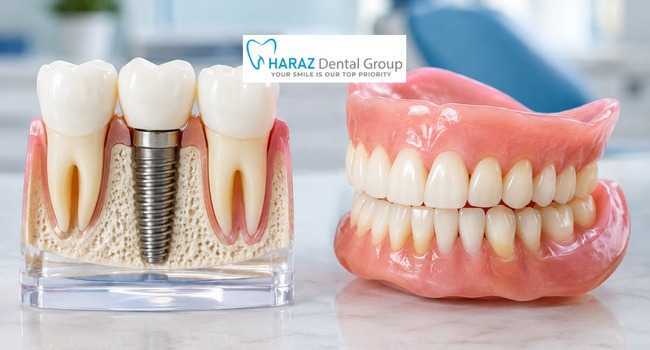
Missing teeth affect more than a smile. They change how you chew, how clearly you speak, and how confident you feel in everyday conversations. If you've been searching "dental implants vs dentures, which is better," you've probably found a lot of generic advice and very few straight answers. The truth is simpler than it seems: both options work, but they work differently, and the right one depends on your bone health, budget, and how you want to live day to day. This guide breaks down exactly what separates the two, so you walk into your consultation already informed.
What Are Dental Implants?
A dental implant is a titanium screw that is surgically inserted into the jawbone and then fuses with the bone tissue as part of the process of osseointegration. This is when a crown is placed on top of an implant during the healing process so that the implant now has both the tooth and root covered. The reason that implants are viewed as the best possible option available for someone needing a replacement tooth is that they work like the root of a tooth.
Benefits of dental implants include:
They look, feel, and work like natural teeth
They help keep the jawbone intact
They can last for a long time, even a lifetime
They don’t move around or require adhesives
Implants typically take three to six months from placement to final crown, depending on healing time and whether bone grafting is needed.
What Are Dentures?
Dentures are removable prosthetic teeth that rest on the gum ridge. They're a faster, non-surgical, and more affordable path to restoring your smile.
Types of dentures:
Full dentures — replace an entire upper or lower arch
Partial dentures — fill gaps while remaining natural teeth stay in place, held by clasps
Implant-supported dentures — a hybrid option where a small number of implants anchor the denture for far greater stability
Key benefits:
Lower upfront cost than implants
No surgery required
Available to patients who may not qualify for implants due to limited bone density or certain health conditions
Dental Implants vs. Dentures: Key Differences
Factor | Dental Implants | Dentures |
Durability | 20+ years, often a lifetime | Typically replaced every 5–10 years |
Bone health | Preserves jawbone density | Bone resorption continues over time |
Comfort & fit | Fixed, no shifting | Can loosen as gums and bone change |
Maintenance | Brush and floss like natural teeth | Daily removal, soaking, and cleaning |
Upfront cost | Higher | Lower |
Long-term value | Often more cost-effective over 15–20 years | May cost more over time due to relines and replacements |
How Much Do Dental Implants and Dentures Cost?
A single dental implant generally runs $3,000–$6,000 depending on bone grafting needs and materials, while full-arch options like All-on-4 range higher per arch. Conventional full dentures average roughly $1,800–$2,500, with partial dentures typically less.
Dentures cost less upfront, but factor in relines, adjustments, and eventual replacement, and the 15–20 year cost gap narrows considerably. That's why many patients ask their dentist for a full lifetime-cost breakdown, not just the sticker price, before deciding.
Who Is a Good Candidate for Implants vs. Dentures?
Dental implants may be right for you if:
Have sufficient jawbone density (or are willing to have a bone graft done if necessary)
Have healthy gums (free from any active periodontal disease)
Are in good health and do not smoke
Wish to opt for a permanent, low-maintenance, and natural-feeling solution
Dentures may be the better fit if:
You have lost considerable amounts of bone that hinder placement of implants
You would rather not undergo surgery
You need to replace most of your teeth, but you do not have enough funds
You have certain medical conditions making surgery not advisable
Neither choice is "settling." For the right patient, a well-fitted denture is a practical, medically sound decision, just as implants are the right call for someone prioritizing long-term bone preservation.
Implant-Supported Dentures: The Middle Ground
If you like the stability of implants but aren't ready for a full set, implant-supported (snap-in) dentures anchor a removable prosthetic to a small number of implants. This hybrid option is more stable than traditional dentures, helps slow bone loss compared to conventional dentures alone, and typically costs less than restoring every missing tooth individually. It's a popular choice for patients across Fresno, Madera, and Tulare County who want more confidence in their bite without the cost of a full-implant restoration.
Getting a Personalized Recommendation
Finding out whether dental implants or dentures are preferable can best be done through a personalized assessment instead of an option like a simple online search. Our staff at Haraz Dental Group can determine your candidacy for dental implants and therefore also for any of our other services, whether they include a single implant, a complete arch restoration, implant-supported dentures, or regular dentures. We will begin by using digital X-ray and CBCT 3D imaging systems to assess your bone density and overall gum health.
We accept patients throughout Fresno, Madera, and Tulare counties, and we participate in most PPO plans, as well as Somos Medi-Cal and Denti-Cal.
Ready to find out which option fits your smile?Schedule your free consultation with Haraz Dental Group today, or call to speak with our team.
Frequently Asked
How do I know if I need dental implants or dentures?
It comes down to your bone density, gum health, budget, and how important a fixed (non-removable) solution is to your daily life. A dental exam with 3D imaging gives the clearest answer.
Are dental implants worth it compared to dentures?
For patients with healthy bone and gums, implants often deliver better long-term value because they don't require frequent relines or replacement, and they help preserve facial structure.
Can dentures be converted to implants later?
Yes. Many patients start with dentures and transition to implant-supported dentures or individual implants once budget, healing, or bone grafting needs are addressed.
Do dentures look as natural as implants?
Modern dentures are custom-fitted and can look very natural, but implants generally offer more stability while chewing and speaking since they don't rely on suction or adhesive.
Is bone grafting always needed before implants?
Not always. Grafting depends on how much bone volume remains, which is why a CT scan is an essential part of any implant consultation.