

- What Is the Difference Between a Dental Crown and a Filling?
- Dental Crown vs Filling: What's the Difference?
- When Is a Dental Filling the Best Choice?
- When Is a Dental Crown the Best Choice?
- Types of Dental Crowns and Dental Fillings
- Pros and Cons of Dental Crowns and Dental Fillings
- Effectiveness of Root Canal Permanent Filling vs. Crown
- Cost Comparison: Tooth Crown vs Filling
- Factors That Determine Whether You Need a Crown or Filling
- Get Appropriate Guidance from Dental Practitioners
- Achieve Optimal Results with Crowns or Fillings at Haraz Dental Group
- FAQs
Sitting in the dental chair and hearing "you need work done on this tooth" is never fun. What makes it worse is walking out without really knowing what comes next. Do you need a crown? Will a filling be enough? And does the difference actually matter?
It does — quite a bit, actually. The wrong choice doesn't just waste money. It can mean going back for more treatment sooner than you should have to. So before you book anything, here's what you genuinely need to understand about both options, written in plain terms without the fluff.
What Is the Difference Between a Dental Crown and a Filling?
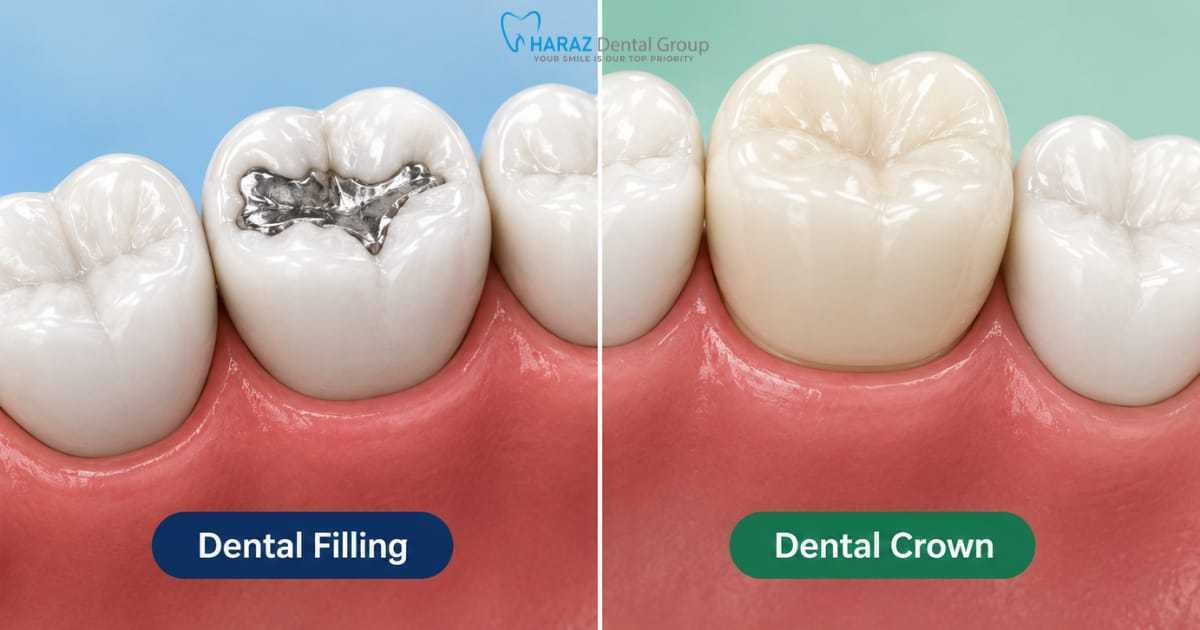
A filling does exactly what the name says. Your dentist drills out the decay, cleans the space and packs it with a material that hardens in place. Most of your original tooth stays exactly as it was — you're just replacing the rotten bit with something solid.
A crown is a whole different thing. Picture a small hollow cap shaped like a tooth. Your dentist files down the damaged tooth so the cap fits snugly over it, then cements it in. The crown becomes the new outer surface of your tooth. It's used when there's too much damage left for a filling to do the job properly.
One repairs a section. The other covers the whole thing. That's the core of it.
Dental Crown vs Filling: What's the Difference?
They both fix teeth, but that's roughly where the similarities end.
Number of visits: A filling is usually done in one appointment, start to finish. A crown takes two — the first to prep the tooth and take impressions, the second to fit the permanent cap.
How much tooth gets touched: With a filling, your dentist only removes the decayed area. With a crown, they reshape the entire tooth so it sits underneath the cap correctly. More of your original tooth gets altered in the process.
Which lasts longer: A well-placed filling can last anywhere from 7 to 15 years. Crowns generally outlast them — 15 years is common and some last well beyond that with decent care.
How much they protect: A filling seals the hole. A crown wraps around the tooth entirely, which makes a real difference for teeth that are cracked, beaten up from grinding or already weakened from prior treatment.
When Is a Dental Filling the Best Choice?
Small cavities are what fillings were made for. If your dentist catches decay early, before it spreads or gets deep, adental filling is usually all you need. Specifically, fillings make sense when:
The cavity hasn't spread to more than one or two surfaces of the tooth
Less than half the tooth is damaged by decay
No cracks are running beyond the cavity itself
The tooth doesn't need a root canal
Minor chips and surface wear can also be handled with a filling. They're quicker to place, cost less and leave most of your natural tooth exactly as it is.
That said, there's a limit. A filling that has to cover most of the chewing surface isn't really giving the tooth support — at that point, it's more likely to cause problems down the line than solve them. That's when your dentist might start talking about a crown instead.
When Is a Dental Crown the Best Choice?
When a tooth has taken too much damage to be reliably held together by a filling, adental crown is the answer. Your dentist will lean toward one when:
The cavity is too big for a filling to anchor to
The tooth is cracked or has fractured
A root canal was done on the tooth (those teeth get brittle — more on that below)
An old filling has broken down and there isn't enough healthy tooth left to simply refill
Grinding has worn the tooth down significantly
You're finishing a dental implant and need a crown placed on top
Crowns also get used for cosmetic fixes — covering a badly stained or misshapen tooth — but their main job is keeping a compromised tooth intact and functional.
Types of Dental Crowns and Dental Fillings
Dental Crowns
Porcelain Crowns: The crown that is the most similar to your natural teeth is porcelain. Porcelain crowns absorb the light in a manner that is similar to natural enamel. It is particularly suited for front teeth, where there is more need to disguise the difference. The negative aspect of porcelain crowns is that they can easily chip.
Ceramic Crowns: All-ceramic crowns skip the metal entirely, which matters if you have sensitivities or just don't want any metal in your mouth. They also age better visually — no dark line showing at the gumline after years of wear. The material has gotten a lot tougher in recent years, so it works on back teeth more often than it used to.
Metal Crowns: If durability is the only thing that matters, metal wins. Gold alloy crowns are nearly impossible to crack and they put less strain on opposing teeth. The reason most people skip them is obvious — they're not invisible. They tend to be reserved for back molars where no one will see them anyway.
Dental Fillings
Composite Fillings: The composite filling is the one that can match your teeth. The composite material bonds directly to your teeth and it also needs lesser drilling compared to other materials. Many people go for the composite filling because it does not stick out when you smile. Although the composite material wears down quickly compared to amalgam, it suits most people.
Amalgam Fillings: Amalgam has been used in dentistry for over 150 years and it earned that track record. It's tough, cheap and handles the constant grind of back teeth better than most alternatives. The silver color is what pushes people away from it now, but if you need something long-lasting in a spot nobody sees, amalgam does the job.
Glass Ionomer Fillings: Glass ionomer is softer than composite or amalgam, but it does something the others don't — it slowly releases fluoride into the surrounding tooth, which helps fight off new decay. It's typically used for smaller cavities near the gumline, kids' teeth or spots that don't bear much chewing load. Don't expect it to last as long in high-pressure areas.
Pros and Cons of Dental Crowns and Dental Fillings
Pros of Dental Crowns
Wraps the whole tooth, giving it real structural protection
Can last 15 to 25 years or more with normal care
Keeps root canal-treated teeth from splitting
Fixes the appearance of badly damaged or discolored teeth
Lets you chew normally again without babying the tooth
Cons of Dental Crowns
Requires removing more of your natural tooth
Costs significantly more than a filling
Takes two appointments instead of one
A loose or poorly fitted crown can trap bacteria over time
Pros of Dental Fillings
Leaves most of your natural tooth untouched
Done in a single visit
Much easier on the budget
Composite fillings are nearly invisible against natural enamel
Cons of Dental Fillings
Not a good option for large cavities or structurally weak teeth
Will need replacing before a crown would
A very large filling can actually make the tooth more fragile over time
Amalgam fillings are visually obvious
Effectiveness of Root Canal Permanent Filling vs. Crown
People ask this a lot after going through a root canal: do I really need a crown or will a permanent filling hold?
For back teeth — molars and premolars — the crown is nearly always the right call. Here's why: during a root canal, the pulp inside the tooth gets removed. That pulp was what kept the tooth hydrated. Once it's gone, the tooth gradually dries out and becomes more brittle than a living tooth. A permanent filling seals the access hole just fine, but it does nothing to stop the tooth from cracking sideways when you bite down on something hard.
Front teeth are a different story. Incisors and canines don't take as much direct force, so a good permanent filling sometimes holds up without a crown. But for anything further back in your mouth, skipping the crown after a root canal is one of the fastest ways to end up needing that tooth pulled altogether. The crown holds the tooth together in a way the filling simply can't.
Cost Comparison: Tooth Crown vs Filling
Let's be real about the numbers.
A composite filling usually runs somewhere between $150 and $300 per tooth. Amalgam is typically a little cheaper. Neither is a huge financial ask, especially with insurance helping.
A crown is a different category of expense. Expect to pay anywhere from $1,000 to $2,000 or more depending on the material and the dentist. Porcelain and ceramic tend to cost more. Metal crowns are usually on the lower end.
Insurance often covers part of both, but co-pays for crowns can still leave a noticeable dent. The thing to keep in mind is that getting a filling on a tooth that actually needs a crown usually means paying for the filling now and the crown later — plus whatever damage happened in between. Doing it right the first time is nearly always cheaper in the long run.
Factors That Determine Whether You Need a Crown or Filling
No dentist decides this on a hunch. Here's what they're actually looking at:
How big the cavity is: A small spot of decay gets a filling. A cavity that's spread across most of the tooth needs a crown.
How much of the tooth is still solid: If more than half the tooth is compromised, a filling doesn't have enough healthy structure to anchor to properly.
Whether the tooth is cracked: A crack almost always means a crown. Fillings don't hold fractured teeth together — they just fill holes.
What's already been done to the tooth: A tooth with a large, aging filling that's starting to fail may not have enough healthy enamel left for another filling to work well.
Where the tooth sits: Molars absorb a lot more force than front teeth. A molar with significant damage almost always ends up needing a crown.
Root canal history: Any back tooth that's had a root canal is a strong candidate for a crown, full stop.
Get Appropriate Guidance from Dental Practitioners
Reading articles helps you prepare for a conversation with your dentist — but it can't replace the conversation itself. X-rays tell part of the story. A physical exam, probing for cracks, checking how deep the decay goes — that's what determines the right answer for your specific tooth.
Go in with questions. Find out from your dentist the degree to which the tooth has been damaged. Ask him whether there are any cracks in it. Ask him what would happen if you were to delay. If you feel rushed in making the decision, you should ask him to slow down. A good dentist will take the time without you feeling embarrassed about doing so.
And if something still doesn't sit right — a second opinion is never a bad move.
Achieve Optimal Results with Crowns or Fillings at Haraz Dental Group
At Haraz Dental Group, we look at the whole picture before recommending anything. Whether your tooth needs a quick filling or a full crown, the goal is always the same: do what's actually right for the tooth, not what's easiest or most profitable.
We know dental treatment can feel stressful, especially when you're weighing costs and time off work. Our team in Fresno takes time to explain what we're seeing, lay out your options honestly and help you make a decision that works for your situation — not just your tooth.
If you've got a cavity that's been sitting too long, a tooth that doesn't feel right or a filling that's been in there since the nineties — come see us. Haraz Dental Group is here to help you figure out exactly what that tooth needs.
FAQs
Which option is more aesthetically pleasing?
Honestly, both can look great when done well. Composite fillings are color-matched to your enamel and blend in to the point where most people can't spot them in a photo. Porcelain and ceramic crowns are shaped and shaded to match surrounding teeth — when they're placed by someone who knows what they're doing, you really can't tell the difference. Front teeth especially tend to come out looking natural with either option.
What is the lifespan of dental crowns and fillings?
A filling will typically last somewhere between 7 and 15 years. Composite tends to wear a little faster in spots that take a beating. Crowns generally make it 15 to 25 years, sometimes longer if you take care of them — metal crowns in particular can outlast everything else. Regular cleanings and checkups help your dentist catch early wear before it turns into a replacement.
Does getting a dental crown or filling hurt?
During the procedure, no — both are done under local anesthesia and you shouldn't feel pain, just some pressure or vibration. Afterward, it's pretty normal to have some sensitivity for a few days, especially around a new crown. That usually settles down on its own and standard over-the-counter pain relievers are enough to deal with it in most cases.
Can a dental crown be placed over a tooth with a filling?
Yes and it happens all the time. When an existing filling has gotten too large, the tooth has started cracking around it or new decay has developed around the edges, placing a crown over the whole tooth is often the logical next step. The crown goes right over the top — filling and all — and gives the tooth a fresh, protected outer surface.
How do I know which option is best for my tooth?
The only real way to know is to have a dentist look at it — X-rays included. They'll check how far the decay has spread, feel for cracks and assess how much healthy tooth structure is still holding things together. Based on all that, they'll give you a recommendation. If you don't fully understand why they're suggesting one over the other, just ask. Understanding your own treatment isn't a strange request — it's a reasonable one.