

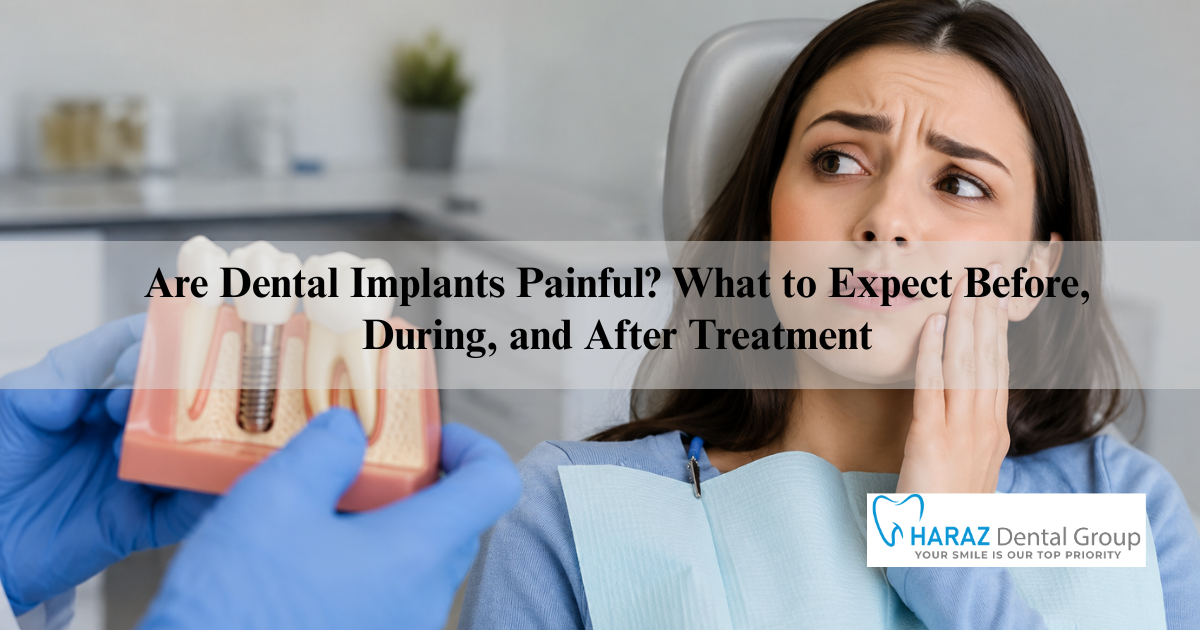
- Are Dental Implants Painful?
- What Happens During Dental Implant Surgery?
- Will I Feel Pain During the Procedure?
- What Does Recovery Feel Like?
- Dental Implant Recovery Timeline
- Pain After Dental Implants: What's Normal?
- Warning Signs You Should Call Your Dentist
- Tips for a Faster Recovery After Dental Implant Surgery
- What Can I Eat After Dental Implant Surgery?
- Are Dental Implants More Painful Than Tooth Extraction?
- Why Most Patients Say Implants Were Easier Than Expected
- Are Dental Implants Worth It?
- Why Choose Haraz Dental Group for Dental Implants in Fresno, CA?
- Frequently Asked Questions
If you're considering dental implants and your first thought is "But how much is this going to hurt?" — you're not alone. It's one of the first questions we hear at Haraz Dental Group, and it's a completely fair one to ask.
The honest answer? Most patients tell us the procedure was far less uncomfortable than they expected. But we know that "most patients" doesn't feel very reassuring when you're the one sitting in the chair. So let's walk through exactly what happens, what you'll feel, and what recovery actually looks like no sugar-coating.
Are Dental Implants Painful?
The procedure itself isn't gonna hurt at all. We will numb your mouth completely before starting anything, so you'll not have any sharp pains during the surgery procedure. After surgery, when the numbing agent wears off, you'll probably have some soreness, swelling and mild discomfort for a while after - like after you get a tooth pulled. The majority of patients handle this fine by using either over the counters.
What Happens During Dental Implant Surgery?
A dental implant is a small titanium post that's surgically placed into your jawbone to replace the root of a missing tooth. Once it fuses with the bone a process called osseointegration a crown is attached on top. The result looks, feels, and functions like a natural tooth.
The surgical part has a few key steps:
Numbing: Your dentist administers local anesthesia to completely numb the area. Sedation options are also available if anxiety is a concern.
Placement: A small incision is made in the gum, and the implant post is carefully positioned into the jawbone.
Closing: The site is stitched up, and the healing process begins.
The whole procedure typically takes one to two hours per implant, depending on complexity. If bone grafting or a tooth extraction is also needed, that adds additional steps which your care team will walk you through in advance.
Interested in seeing if you're a candidate? Ourdental implants page has a detailed overview of the full treatment process.
Will I Feel Pain During the Procedure?
This is the question that keeps people up at night, and the answer is reassuring: no, you should not feel pain during the surgery itself.
Local anesthesia fully blocks pain signals in the treatment area. You may feel pressure the sensation of something happening — but not sharp or piercing pain. If at any point during the procedure you feel something uncomfortable, you can signal your dentist immediately. A bit more anesthetic resolves that quickly.
For patients with dental anxiety, sedation dentistry is an option worth discussing. Many patients in Fresno who come to us having dreaded the procedure for years report that it was genuinely easier than they anticipated.
What Does Recovery Feel Like?
This is where we want to be realistic with you. The surgery itself is comfortable, but recovery does involve some discomfort. Knowing what to expect makes it much easier to manage.
In the first 24–48 hours, expect:
Swelling around the jaw, cheek, and possibly under the eye
Mild to moderate soreness at the surgical site
Some bleeding — light oozing is normal, especially on day one
Jaw stiffness, particularly if you were open for an extended procedure
The good news is that this discomfort is predictable and temporary. Prescription-strength pain medication isn't always necessary most patients do well with ibuprofen or acetaminophen as directed.
Dental Implant Recovery Timeline
First 24 Hours
This is when swelling and discomfort peak. Rest is important. Bite gently on gauze if there's bleeding. Avoid hot foods and drinks, don't spit forcefully, and skip the straw suction can disturb the clot forming at the surgical site. Sleep with your head slightly elevated.
Cold compresses (20 minutes on, 20 off) do a lot of work here to manage swelling.
Days 2–7
Swelling usually peaks around day two or three, then gradually subsides. The soreness will ease noticeably by days four through six. Soft foods are your best friend during this window — think yogurt, scrambled eggs, mashed potatoes, smoothies, and soup. Avoid anything hard, crunchy, or chewy near the implant site.
Most people return to desk work or light daily activities within two to three days. Physical labor or intense exercise should wait at least a week.
Weeks 2–6
By the end of the first week, most patients feel close to normal. Stitches (if non-dissolving) are typically removed around day seven to ten. The implant site continues to heal underneath the gum, even though outwardly everything looks fine.
This phase is all about osseointegration — the implant fusing with the surrounding bone. You won't feel this happening, and theres nothing you need to do except keep the area clean and avoid putting undue pressure on it.
Long-Term Healing
Full osseointegration takes three to six months, depending on your bone density and overall health. Once the implant has fully integrated, your dentist will attach the final dental crown. At that point, your new tooth is functionally indistinguishable from a natural one.
Pain After Dental Implants: What's Normal?
Normal post-surgical discomfort follows a predictable curve: it starts moderate, peaks in the first two to three days, and steadily decreases from there. By the end of the first week, most patients aren't reaching for pain medication anymore.
Normal symptoms include:
Soreness or tenderness around the implant site
Swelling in the jaw and cheek
Minor bruising on the face or neck
Sensitivity when eating or drinking
A slight throbbing sensation in the first day or two
What you feel should be manageable and getting better, not worse.
Warning Signs You Should Call Your Dentist
While discomfort is expected, certain symptoms are not normal and warrant a call to your dentist right away.
Contact Haraz Dental Group if you experience:
Worsening pain after day three — improvement should be the trend, not escalation
Fever above 101°F — could indicate infection
Significant, persistent bleeding beyond the first day
Implant that feels loose or shifts — this should never happen
Difficulty swallowing or breathing — seek emergency care
Pus or unusual discharge from the surgical site
Numbness that doesn't resolve after the anesthesia should have worn off
These situations are uncommon, but catching complications early makes a significant difference in outcomes. When in doubt, call us — we'd always rather hear from you.
Tips for a Faster Recovery After Dental Implant Surgery
Small choices in the first week make a real difference in how smooth your recovery feels.
Do:
Take medications as prescribed or directed, even if you feel okay
Apply ice packs during the first 24–48 hours to reduce swelling
Rinse gently with warm salt water starting day two
Eat soft foods and stay hydrated
Keep your head elevated, especially when sleeping
Brush carefully around (not directly on) the surgical site
Avoid:
Smoking, this is one of the most significant factors in implant failure and delayed healing
Alcohol, especially in the first 72 hours
Vigorous rinsing or spitting
Hard, crunchy, or spicy foods
Strenuous exercise for the first week
Touching the site with your tongue repeatedly
What Can I Eat After Dental Implant Surgery?
Stick to soft, cool or lukewarm foods for the first week. Good options include yogurt, smoothies (no straw), mashed potatoes, scrambled eggs, soup broth, and soft fish. Avoid anything hard, crunchy, sticky, or very hot for at least seven days.
Are Dental Implants More Painful Than Tooth Extraction?
This is a fair comparison, because many implant patients have already been through an extraction. The general consensus both from patients and clinicians — is that implant surgery is comparable to or slightly more involved than a standard extraction, but the recovery experience is very similar.
If you've already had atooth extraction and got through it, you have a realistic baseline for what implant surgery feels like. The post-op soreness and swelling follow the same general pattern.
Why Most Patients Say Implants Were Easier Than Expected
There's a consistent pattern we see at Haraz Dental Group: patients who were the most anxious going into the procedure often come out saying it was nothing like what they feared.
A few reasons for that gap between expectation and experience:
Modern anesthesia works remarkably well. Dental anesthesia today is highly effective and precisely administered. Feeling sharp pain during the procedure is genuinely rare.
The procedure is controlled and predictable. Unlike dental emergencies — which are painful precisely because they're sudden and uncontrolled — implant surgery is planned, methodical, and performed in a comfortable environment.
Patients are prepared. When you know what's coming, the anxiety decreases, and the perceived discomfort does too. This article exists for exactly that reason.
The outcome changes daily life. Patients who've beenliving with missing teeth — dealing with bone loss, shifting teeth, or embarrassment — often feel that a week of recovery was more than worth what they gained on the other side.
Are Dental Implants Worth It?
For the right candidate, yes — consistently and significantly. Dental implants are the only tooth replacement option that preserves jawbone, prevents the shifting of surrounding teeth, and functions like a real tooth. They don't need to be removed, they don't require adhesives, and with good oral hygiene, they can last decades.
The discomfort is temporary. The benefit is permanent.
Why Choose Haraz Dental Group for Dental Implants in Fresno, CA?
At Haraz Dental Group, we've helped hundreds of patients throughout Fresno and the broader Central Valley restore their smiles with dental implants. We understand that the decision to move forward is often held back by fear — not just of the procedure itself, but of the unknown.
That's why we take time to walk every patient through exactly what their treatment will involve before anything begins. You'll know what to expect, what's normal, and when to call us.
We offer:
Thorough implant consultations with no-pressure guidance
Sedation options for anxious patients
A team experienced in complex cases, including bone grafting when needed
Clear aftercare instructions and accessible follow-up support
Serving patients throughout Fresno, CA and the surrounding Central Valley
If you've been putting off this decision because you're worried about pain, let's talk. Most of the time, the conversation itself is enough to put those fears to rest.
Ready to take the next step?Schedule a dental implant consultation with Haraz Dental Group in Fresno, CA today. We'll answer every question you have — honestly.
Frequently Asked Questions
How painful is dental implant surgery?
The surgery itself is not painful because the area is fully numbed with local anesthesia. Afterward, most patients experience mild to moderate soreness and swelling for three to five days, manageable with over-the-counter pain relievers like ibuprofen.
How long does dental implant pain last?
Most discomfort resolves within five to seven days. The first two to three days are the most uncomfortable as swelling peaks. By the end of the first week, the majority of patients feel near-normal with no need for pain medication.
How long is dental implant recovery?
Initial recovery the period of noticeable soreness and dietary restrictions takes about one to two weeks. Full healing, meaning the implant fully fusing with the jawbone (osseointegration), takes three to six months before the final crown is placed.
When should I be concerned about pain after a dental implant?
Call your dentist if pain is getting worse after day three instead of better, if you develop a fever, notice pus or unusual discharge, see persistent heavy bleeding, or feel that the implant is loose. These are signs of potential complications that need prompt attention.
Are dental implants more painful than getting a tooth pulled?
Most patients report the experiences are comparable. Implant surgery may be slightly more involved depending on complexity, but the post-operative discomfort soreness, swelling, and a few days of soft-food diet follows a very similar pattern to a standard extraction.
Do dental implants hurt long-term?
No. Once the implant has fully healed, it should feel no different from a natural tooth. There is no ongoing pain associated with a successfully integrated dental implant. If pain develops months or years after placement, it should be evaluated by a dentist promptly.